VO₂ max (or VO2 max) is the maximum amount of oxygen your body can use per minute, in millilitres per kilogram. The higher it is, the more energy your client can produce and the easier everyday activities feel. It is one of the best markers of health and longevity. To improve it, you vary training intensities and track progress over time, rather than chasing a single number.
In an episode of the Hexfit podcast, I spoke with Joël Blanchard, exercise physiologist, about VO₂ max. Here is what to take away to support your clients.

Joël Blanchard is an exercise physiologist who runs the physiology lab at the University of Ottawa. Trained as a kinesiologist, he completed a master's degree on cardiorespiratory exercise testing in young people, then a PhD in human kinetics on the link between motor development and cardiorespiratory fitness. He specializes in physical literacy. At Motrix, he coaches around forty runners, cyclists and triathletes, and he launched a women's cycling team that makes the sport accessible to women with irregular schedules.
This article is based on an episode of the Hexfit podcast recorded in French. You can watch the full interview on YouTube with automatic translated subtitles.
What does VO₂ max actually measure?
To produce energy, the body needs two things: food (mostly carbohydrates and fats) and oxygen. VO₂ max measures the second part of the equation: how much oxygen your client can deliver to the mitochondria in their muscles, per minute and per kilogram of body weight (mL/kg/min).
It is expressed relative to body weight so you can compare two people of different builds. A heavier person has more muscle, so they use more oxygen in absolute terms.
Key takeaway: a high VO₂ max means a bigger “engine”. Your client runs faster, rides harder and climbs stairs without getting out of breath.
Why is VO₂ max such a good marker of health?
Every daily activity requires oxygen: climbing stairs, pushing a shopping cart, chasing after the kids. Joël gives the example of his 68-year-old aunt. For her, with a VO₂ max of around 20, climbing stairs becomes a hard effort. For him, at 70, it is a very light one.
« There's a reason people say VO₂ max is the best marker of longevity. »
Joël Blanchard (translated from French)
Research points the same way. In a Cleveland Clinic study of 122,007 adults followed for 8 years on average, low cardiorespiratory fitness was associated with a mortality risk equal to or greater than smoking (Mandsager et al., JAMA Network Open, 2018). The American Heart Association even recommends assessing cardiorespiratory fitness as a vital sign, just like blood pressure (Ross et al., Circulation, 2016).
Why focus on VO₂ max rather than weight loss?
This is the key message of the episode. According to Joël, your clients’ goal should never be to lose weight, but to have a good VO₂ max. The rest follows.
The math is simple: using 1 litre of oxygen burns about 5 calories. The more oxygen your client can use, the more energy they burn during exercise:
- an elite cyclist burns 900 to 1,100 calories in an hour of steady effort;
- an average person burns 300 to 400 on the same bike;
- a very deconditioned person (VO₂ max around 20) often can’t pedal for an hour.
“Have you ever seen someone with a VO₂ max of 60-70 who is obese? The answer is no,” Joël sums up. Those people usually struggle to eat enough.
The two are linked: when VO₂ max goes up, resting metabolic rate is likely to go up too. Repeated calorie deficits, on the other hand, lower resting metabolic rate and hold back VO₂ max development.
How is VO₂ max measured?
In the lab
The gold standard is indirect calorimetry. Your client wears a mask during a graded exercise test: it starts very easy and ends at maximal effort. The machine analyses exhaled air to estimate how much oxygen is being used.
With a smartwatch
A watch doesn’t measure oxygen. It estimates VO₂ max with an algorithm that combines heart rate, age, sex, height, weight and speed over a distance. Garmin, Apple and the others don’t publish their formulas.
The estimate is still useful, because the watch is worn day and night and collects a lot of data. Two pitfalls to know about:
- The weight entered in the watch changes the result. If your client wants to track their VO₂ max closely, their weight must be up to date in the device.
- The number doesn’t replace how they feel. Joël often sees athletes trust their watch (“my watch says I’m fine”) when they don’t feel good. Sleep scores and heart rate variability can be wrong too.
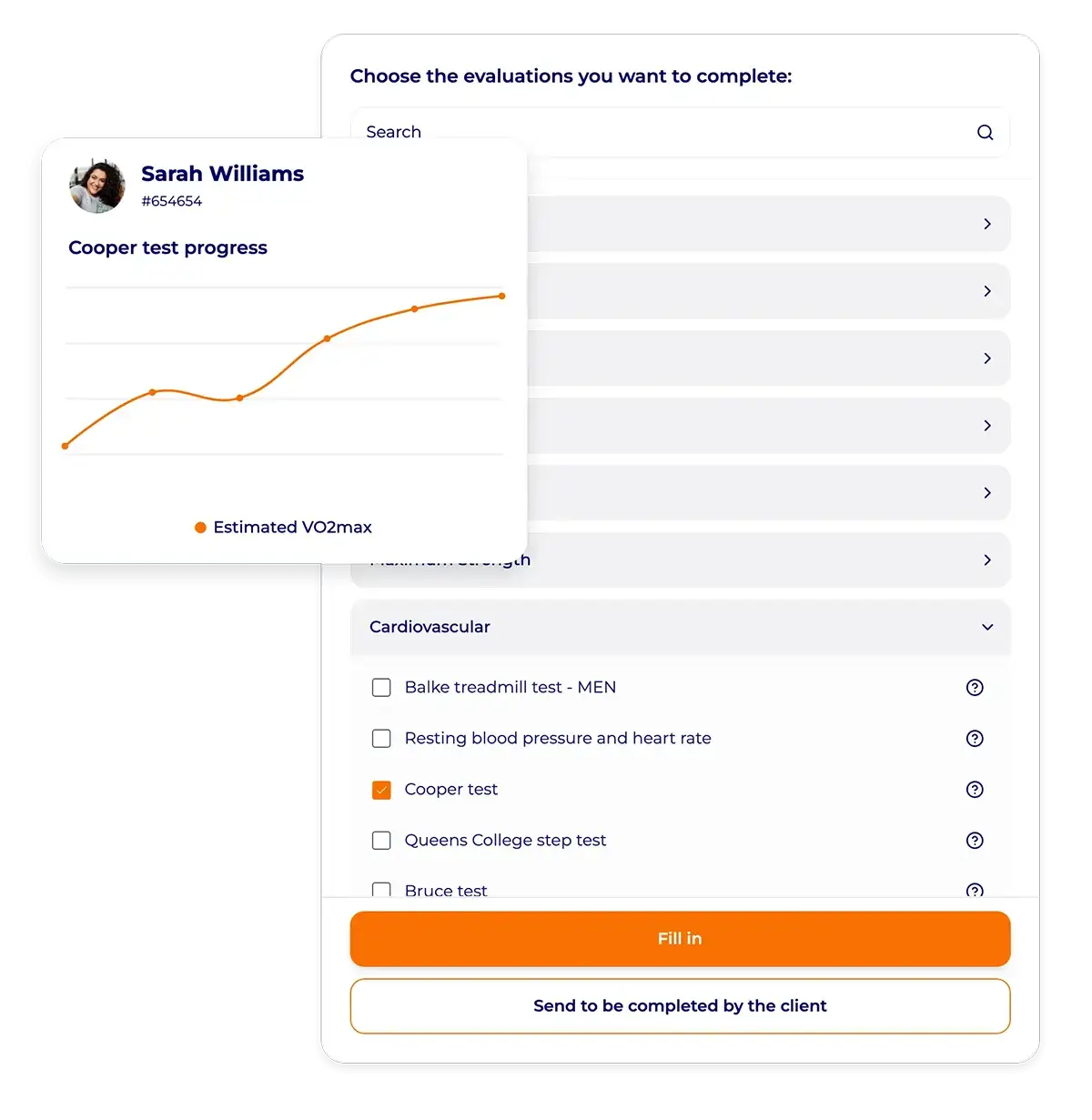
Look at the trend rather than the exact number. For most of your clients, what matters is how their own value changes over time, not how it compares to someone else’s.
What is a good VO₂ max?
Joël is wary of reference charts: a single number reassures people too quickly. His benchmarks for good health:
- for women: around 40 to 45 mL/kg/min;
- for men: around 45 to 50 mL/kg/min.
The best benchmark is still how your client feels. If they can handle their daily activities, work and sport without it being a struggle, their VO₂ max is probably fine. The goal is to maintain it and improve it over time.
Is higher always better?
Not necessarily. The best endurance athletes go above 90, and triathlete Kristian Blummenfelt reported a value of around 101 (a figure shared on his social media, not yet independently verified). Those levels require up to 30 hours of training a week and 250 to 300 g of carbohydrates per hour during exercise. For Joël, very high performance has a physiological cost, and the long-term health of these athletes raises questions. For your clients, aim for a VO₂ max that is high in a healthy way, compatible with their work, family and recovery.
How do you improve your clients’ VO₂ max?
VO₂ max depends on a long chain: breathing, heart, blood, muscles, mitochondria. To improve it, you need to work on several links, at different intensities and at different times of the year.
- Vary the intensities. The polarized 80/20 model (80% low intensity, 20% high intensity) is a good base. Depending on the phase, Joël also uses 90/10 or 40/40/20 (low, moderate, high).
- Don’t only do “VO₂ max” sessions. They only train a few links, and stacking too many leads to fatigue and injuries.
- Plan ahead. That’s the role of training periodization: what to do, and when to do it.
- Individualize. A man and a woman, or two clients of the same age, don’t respond the same way to the same sessions.
- Focus on consistency. The heart adapts through small gains, day after day, week after week.
« Developing VO₂ max is a process of marginal gains, day after day. You don't build a VO₂ max over 20 years only to lose it in 2 weeks because you went on vacation. »
Joël Blanchard (translated from French)
How do you track progress without retesting every month?
A VO₂ max test is expensive, requires a day or two of recovery and is easily skewed (one bad night is enough). Joël saves it for athletes who have plateaued for a while.
The rest of the time, he follows around forty athletes using their training zones:
- Compare how they feel with the prescribed zone. An easy session that feels exhausting signals a problem. A hard session that feels easier than before signals progress.
- Look for context. Sleep, nutrition, work, a night out: these often explain a bad session.
- Adjust the zones when your client responds better than expected.
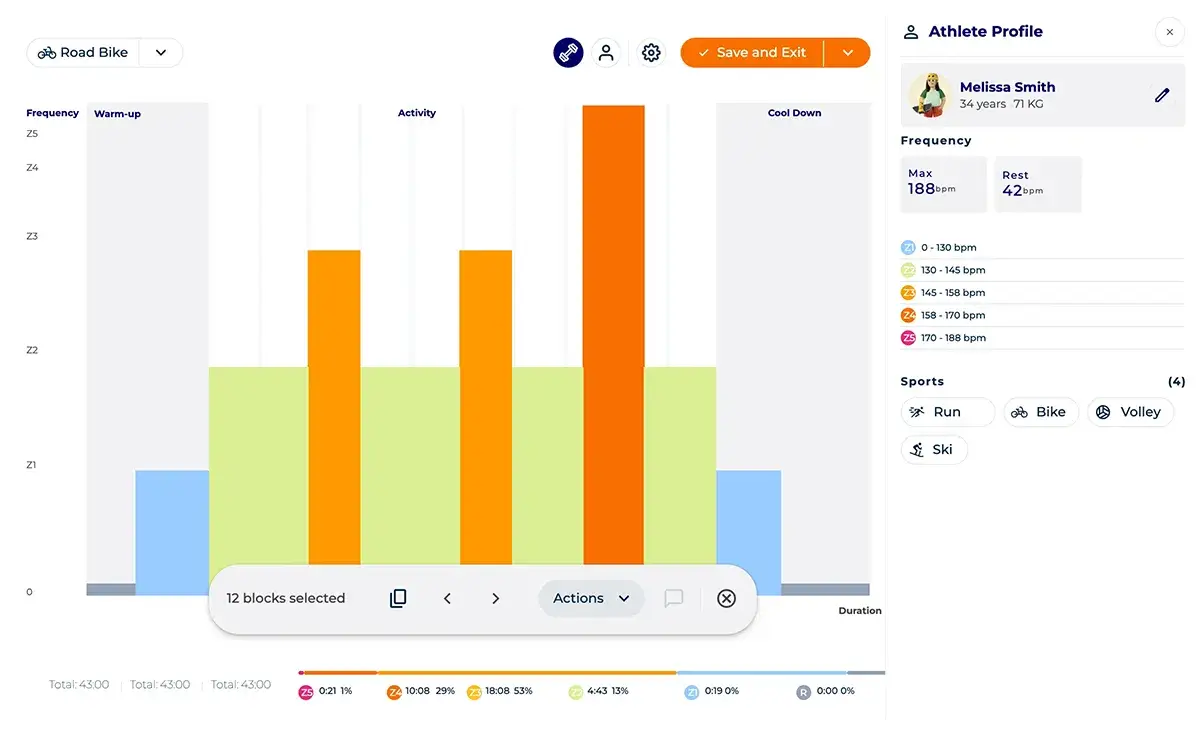
According to Joël, this is where your role as a professional makes the difference: connecting the prescription to the other areas of your client’s life.
« Artificial intelligence is a tool. But it isn't the absolute truth. Our job, as practitioners, is to connect the prescription to the other areas of life. »
Joël Blanchard (translated from French)
Client tracking software helps you keep all of this data and communication in one place.
Can you improve VO₂ max at any age?
Yes. At 12, Joël reached stage 6 of the beep test and walked during a 2 km run. At 34, he has the best VO₂ max of his life.
Three things are worth separating:
- absolute potential, what you would have reached by doing everything right since childhood;
- current potential, reduced by what you have lived through;
- current capacity, your client’s starting point today.
With age, sarcopenia (loss of muscle mass) and dynapenia (loss of power) reduce the ability to use oxygen. But a client aged 50, 64 or 68 can still progress.
What about after a long break?
A sporting background helps you bounce back faster. Heart adaptations build slowly and fade slowly: two or three weeks off don’t erase years of training. Muscle adaptations, on the other hand, fade and return more quickly. After a break, your client will have heavy legs for one or two weeks, then get their feel back.
Advice to give: during busy periods (a new baby, work), staying active, even at a lower volume, keeps most of the gains.
Frequently asked questions
What is a normal VO₂ max?
For good health, Joël Blanchard gives benchmarks of around 40 to 45 mL/kg/min for women and 45 to 50 for men. How you feel day to day matters as much as the number.
Is a smartwatch VO₂ max reliable?
It’s an estimate, calculated from heart rate, age, sex, height, weight and speed. It’s useful for tracking a trend, as long as the weight entered in the watch is up to date.
How do you increase VO₂ max?
By varying intensities (for example 80% at low intensity and 20% at high intensity), with year-round planning and plenty of consistency. Very high-intensity sessions alone aren’t enough.
How often should you retest VO₂ max?
There’s no need to retest often. A lab test is useful when an athlete plateaus. The rest of the time, tracking training zones and how the athlete feels is enough to see progress.
Can you increase VO₂ max after 50?
Yes. Potential decreases with age and training history, but an active person can keep progressing at any age.
Why focus on VO₂ max rather than weight loss?
Because a higher VO₂ max lets you burn more energy during exercise: about 5 calories per litre of oxygen used. It’s a healthier, more sustainable way to influence body composition.
Learn more
- Watch the full episode (in French): VO₂ max with Joël Blanchard
- Joël’s previous episode (in French): Physical literacy
- Follow Joël on Instagram: @joel.motrix