2026 Guide
How to build a coaching app in 2026: from scratch or on top of a platform?
Updated October 29, 2026 · Written by the Hexfit team
A fitness coaching app has about twenty building blocks: an iOS and Android app, programs, progress tracking, messaging, payments, health data security, app store publishing and updates. With an AI tool like Lovable or Claude, you can build a prototype in a weekend. A reliable app in production takes months. The fastest route: start from a coaching platform and only code what is missing.
Who wrote this guide?
This guide is written by the Hexfit team. Hexfit is our software: we use it as an example of a platform you can customize, and we also explain when building from scratch is the better choice. The information comes from our public technical guides, our pricing page and vendors’ websites, checked in October 2026. Spot an error? Message us through the site chat and we’ll fix it.
What does a coaching app actually need?
Here is what your clients expect from a coaching app, and what each building block takes if you start from scratch.
| Building block | From scratch | With Hexfit |
|---|---|---|
| Accounts and login | Code and secure it (passwords, sessions, account deletion) | Included |
| Client records | Design the database | Included, shareable with a physical therapist or dietitian |
| Program builder | Code sets, reps, supersets and rest times | Included, also from ChatGPT or Claude |
| Exercise video library | Film or buy videos, then host them | Included, plus your own YouTube or Vimeo videos |
| iOS and Android app | Two platforms to build and test | Hexfit Go app included |
| App store publishing | Apple ($99 a year) and Google ($25) developer accounts, Apple review for every release | Your own app: $99/month add-on (billed annually) on the Studio plan, published by Hexfit in about a month |
| Messaging | Code it or plug in a paid service | Included |
| Notifications | Set up for iOS and Android | Included |
| Nutrition | Find and license a food database | Add-on on Solo, included from Growth |
| Progress tracking and charts | Code calculations and charts | Included, charts shareable with the client |
| Questionnaires | Code forms and reminders | Included, sent automatically before or after a session |
| Wearables | One integration per data source | Included: every smartwatch syncs |
| Billing | Payment provider and compliant invoices | From Solo |
| Calendar and appointments | Code it | From Solo |
| Groups and announcements | Code it | From Growth |
| Automations | Code and monitor scheduled jobs | No code from Growth, 9 Hexfit AI credits per run |
| AI assistant | Pay-per-use AI model keys | ChatGPT and Claude on every plan, no credits used; Copilot subject to its vendor’s terms |
| Health data | Compliant hosting, encryption, privacy laws (GDPR, HIPAA, PIPEDA depending on your country) | ISO 27001 certified, HDS certified and GDPR compliant |
| Hosting and backups | Monthly bills and monitoring | Included |
| iOS and Android updates | Redo with every new OS version | Handled by Hexfit |
Hexfit prices taken from our pricing page on October 29, 2026, in USD. Apple and Google fees taken from their developer sites. Prices change: check them before you subscribe.
How much does it cost to build a coaching app from scratch?
The prototype costs almost nothing: Lovable’s paid plans start around $25 a month. The real cost comes later, when the app has to run every day with real clients.
- Development. We estimate a complete first version of a coaching app at $30,000 to $50,000 in 2026, even with a team that codes with AI: iOS and Android, server, database and several months of work.
- Infrastructure. Compliant hosting for health data, notifications, video storage: monthly bills that grow with your client count.
- App stores. Apple account at $99 a year, Google account, Apple review for every update.
- Maintenance. Every new iOS or Android version can break your app. Someone has to fix it, often fast.
- Your time. Every hour spent debugging is an hour not coaching.
When building from scratch makes sense
Building your own app from scratch is the right call if:
- the app is your product. You want to sell software to others, not coach your own clients;
- your idea goes beyond coaching. A game, a social network, connected hardware: no coaching platform will be a good base;
- you have a tech team and a budget to maintain it for years.
In other cases, as for most coaches, studios and strength and conditioning coaches, you save months by starting from an existing platform.
Customizing Hexfit: 5 ways to get your own app
Hexfit covers most of these building blocks. For what is unique to your method, you have five levers, from simplest to most technical.
1. Your colors, your own app
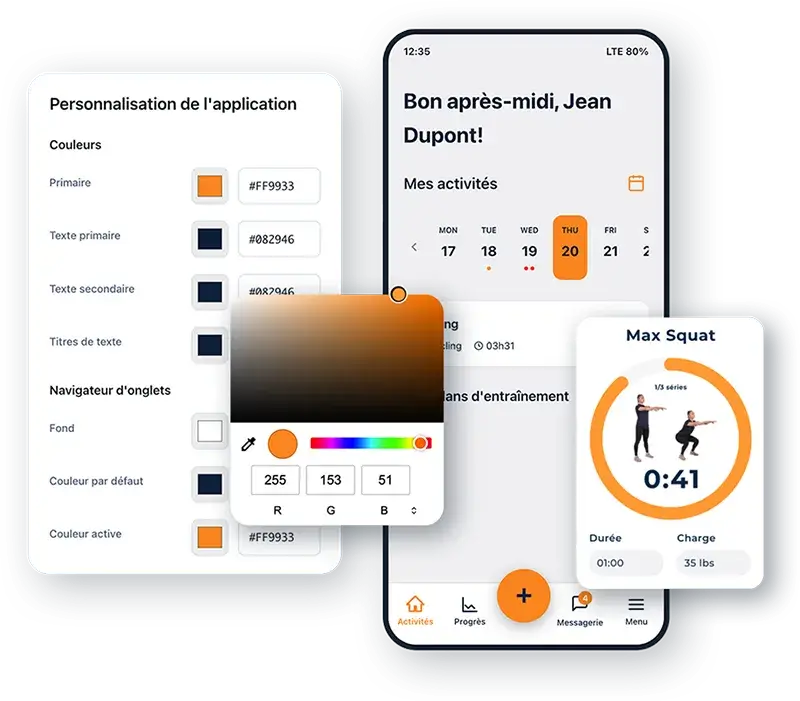
From the Growth plan ($90 a month), your clients’ Hexfit Go app takes on your colors. For your own app on the App Store and Google Play, under your name and with your icon, add the $99/month add-on (billed annually) to the Studio plan: Hexfit handles development, publishing and updates.
2. Automations
A trigger, one or more actions, no code. Add every new client to a group, assign a default program, send a questionnaire after each session, create daily tasks, get an alert when a data point is out of range. Automations can also exchange data with your other apps. From Growth, 9 Hexfit AI credits per run.
3. ChatGPT, Claude or Copilot
Connect your AI assistant to your Hexfit account. Ask it in plain language to find a client, create a session with supersets, sets and rest times, or build a full program. Create it as a draft first so you can check it before your client sees it.
4. Custom tiles
A tile is a small web app you build and Hexfit displays inside your clients’ app. When it opens, Hexfit passes the client’s first name, last name, email and an access key: your tile knows who opened it and can read their Hexfit data. Build it with Lovable, Bolt or Claude, then send the link to Hexfit, which adds it to the app. Available from the Growth plan.
5. The open API
To go further, the Hexfit API reads your account’s data and triggers actions in it. An administrator generates the key from Hexfit’s administration, Integrations tab. The API is limited to 500 calls a month, plus hourly and daily limits. Documentation is public at docs.hexfit.com; API technical support is reserved for the Studio and Institutional plans.
Try all 5 levers for 14 days
How to build your coaching app on Hexfit in 5 steps
- List your needs. Write down everything your clients should be able to do in your app.
- Check off what Hexfit already covers. Use the table above: usually one to three features specific to your method remain.
- Automate what repeats. Onboarding new clients, questionnaires, follow-ups, alerts.
- Code only what is missing, as a tile. A calculator, a membership card, a monthly challenge: one tile per need, built with your favorite AI tool.
- Add your brand. Your colors from Growth, then your own app in the stores as your business grows.
To build your tile step by step, follow the custom tiles developer guide.
Three real-world examples
Independent personal trainer
Hexfit handles programs, messaging and billing. The trainer adds a “calorie needs calculator” tile built their own way with Lovable. Clients find it right in the app.
Strength and conditioning coach
Tracking and wellness questionnaires run in Hexfit. An automation sends the questionnaire every morning, and the coach gets an alert when an athlete reports pain. Through the API, the coach pulls the data into the club’s dashboard.
Fitness studio
The studio publishes its own app in the stores, under its name. It adds two tiles: the membership card and the shop. Every new member is automatically added to the right group and gets their onboarding program.
Frequently asked questions about building a coaching app
Can you build a coaching app with ChatGPT, Claude or Lovable?
Yes, for a prototype: these tools generate screens, a database and logic in a few hours. For an app in production, you still need to handle the iOS and Android app, the app stores, health data security, hosting and updates. A faster option: use these tools to build custom tiles inside an existing platform like Hexfit.
How much does a coaching app cost?
A prototype built with an AI tool costs a few dozen dollars a month. A complete first version on iOS and Android costs $30,000 to $50,000 by our estimate, plus hosting and maintenance. On Hexfit, the Hexfit Go app is included from $19 a month (Starter, 5 clients) or $50 (Solo). It takes on your colors from Growth ($90 a month). Your own app in the stores is a $99/month add-on, billed annually, on the Studio plan ($250 a month).
How long does it take to launch a coaching app?
From scratch, expect several months for a reliable first version, plus app store review. On Hexfit, you can coach your clients the same day in the Hexfit Go app. Your own branded app is published on the App Store and Google Play in about a month.
Do I need to know how to code to have my own coaching app?
No. Programs, tracking, automations and white labeling are set up without code. Code is only needed for custom tiles and the API, and an AI tool can write it for you. For a tile that touches your clients’ data, get help from a technical person.
Can I have a coaching app under my own brand?
Yes. From the Growth plan, your clients’ Hexfit Go app takes on your colors. With the white label add-on on the Studio plan, your own app is published on the App Store and Google Play under your name and with your icon. Hexfit handles publishing and updates.
Can I add my own features to Hexfit?
Yes, with custom tiles. You build a small web app, send its link to Hexfit, and it shows up in your clients’ app. It receives the client’s first name, last name, email and an access key, and can read their data through the API. Tiles are available from the Growth plan.
Does Hexfit have an API?
Yes. The Hexfit API is open and documented at docs.hexfit.com. An administrator generates the key from Hexfit’s administration, Integrations tab. The API is limited to 500 calls a month, with hourly and daily limits to prevent abuse. API technical support is reserved for the Studio and Institutional plans.
Is my clients' data secure?
An app built from scratch must comply with privacy laws on its own (GDPR in Europe, HIPAA in the US, PIPEDA in Canada) and use compliant hosting for health data. Hexfit is ISO 27001 certified, HDS certified and GDPR compliant. In a tile, always use HTTPS and never store the access key.